|
A Duality of Dualities |
|
|
|
Each resident has their reverse, |
|
With asymptotics free, |
|
They’re treated by an anti-Nurse |
|
For supersymmetry. |
|
|
|
In another article we discussed the interesting duality between triples a,b,c and A,B,C of vectors in three-dimensional space, where the latter vectors are defined in terms of the former by the cross products |
|
|
|
|
|
|
|
where V = (a x b)‧c is the volume of the parallelepiped with edge vectors a,b,c emanating from a vertex. With this definition, we have the same volume V = (A x B)‧C for the “dual” parallelepiped with edge vectors A,B,C, and we have the dual relations |
|
|
|
|
|
|
|
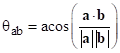
Letting θab denote the angle between the vectors a and b, etc., we have |
|
|
|
|
|
|
|
and similarly for the angles between other pairs of vectors. Now, inserting the expressions for B and C into the expression for a, we get |
|
|
|
|
|
|
|
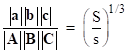
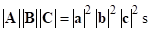
where we’ve made use of the fact that c x a and a x b are both perpendicular to a, and therefore their cross product is parallel to a, and the fact that the magnitude of a cross product of two vectors is the product of their magnitudes and the sine of the angle between them. This shows that the numerator in parentheses equals V, and similarly for the expressions from the relations for b and c. Incidentally, if we multiply these three expressions for V together and take the cube root, we get |
|
|
|
|
|
|
|
where |
|
|
|
|
|
|
|
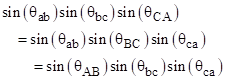
We also have the equality of the three expressions |
|
|
|
|
|
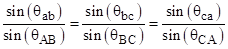
which implies that |
|
|
|
|
|
|
|
Furthermore, as discussed in another note, if we define the function |
|
|
|
|
|
|
|
the volume V can also be expressed as |
|
|
|
|
|
|
|
From the two previous expressions for V we also have |
|
|
|
|
|
|
|
From the definitions of A,B,C we have |
|
|
|
|
|
|
|
Another interesting set of relations comes from the Binet-Cauchy identity (u x v)‧(m x n) = (u‧m)(v‧n) – (u‧n)(v‧m), which allows us to write in terms of the unit vectors in the a,b,c directions |
|
|
|
|
|
|
|
Then, making use of the trigonometric relations for unit vectors u‧v = cos(θuv) and u x v = sin(θuv), and noting that a x b is in the C direction, and b x c is in the A direction, we can express the two sides of this equality as |
|
|
|
|
|
|
|
Thus we have |
|
|
|
|
|
|
|
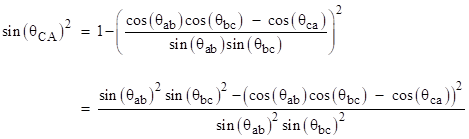
Substituting this into sin(θCA)2 = 1 – cos(θCA)2, we get |
|
|
|
|
|
|
|
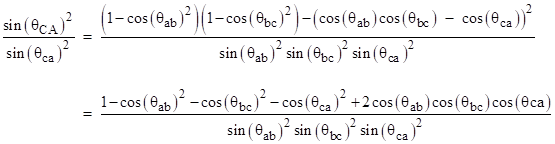
Dividing both sides by sin(θca)2, this gives |
|
|
|
|
|
|
|
Taking the square root and reciprocal of both sides, we have |
|
|
|
|
|
|
|
By symmetry, the same analysis leads to the same result for the other cyclic permutations, we we have |
|
|
|
|
|
|
|
Also, by the symmetry between the dual parallelepipeds, we have |
|
|
|
|
|
|
|
Hence the right hand sides of this and the previous similar expression are reciprocals. |
|
|
|
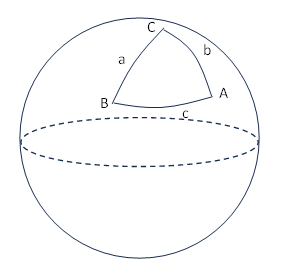
All the above was based on analyzing the dual parallelepipeds from their edge lengths and angles, but readers familiar with spherical trigonometry will have recognized (nearly) all these relations as being identical to those involving the central and surface angles of spherical triangles. A spherical triangle on the surface of a unit sphere is depicted in the figure below. |
|
|
|
|
|
|
|
The edges of the triangle are great circle arcs on the surface, and the symbols A,B,C denote the angles at the vertices. The symbols a,b,c denote the arc lengths of the respective “edges”, and since this is a unit sphere, these are also the angles of the rays emanating from the center of the sphere to the vertices delimiting the edges. The fundamental trigonometric relation is called the first law of cosines (for sides in terms of one angle), which is |
|
|
|
|
|
|
|
and the similar relations for the other cyclic permutations. This is identical in form to equation (1), except that the right hand side is negated (due to sign convention). However, recall that in our derivation of the subsequent results, such as equations (2), which are called the law of sines in spherical trigonometry, we dealt only with the square of this quantity, so we get the same results. All the angular identities and relations for the dual parallelepipeds are formally the same as the relations for spherical triangles. |
|
|
|
This correspondence was to be expected, when we consider the so-called dual triangle, whose vertices are poles of the great circles on which the edges of the original triangle lie. In other words, the dual vertex is on the axis of the great circle containing a given edge. If we denote the angles of this dual triangle by primes, then we find they occur in supplementary pairs, i.e., |
|
|
|
|
|
|
|
The rays to the vertices of the dual triangle are the cross-products of the rays to the vertices of the original triangle. Thus, the unit vectors emanating from the center of the sphere to the vertices of the original triangle correspond to the (directions of the) edges of the original parallelepiped, and the unit vectors emanating from the center of the sphere to the vertices of the dual triangle correspond to the (directions of the) edges of the dual parallelepiped. |
|
|