|
Triangulated Triangle to Tetrahedron |
|
|
|
I recall a box of rags that someone gave us |
|
And how my mama put the rags to use. |
|
Dolly Parton, 1971 |
|
|
|
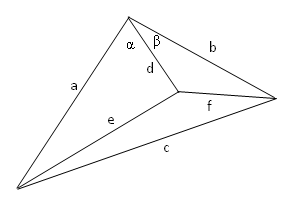
Given an arbitrary triangle, draw lines from the vertices to some arbitrary point in the interior, as illustrated below. |
|
|
|
|
|
The edge lengths of the overall triangle are a,b,c, and the lengths of the segments from the vertices to the interior point are d,e,f. The angle between segments a and d is denoted by α, and the angle between segments b and d is denoted by β. Given the values of five of the six segment lengths, how would we compute the value of the sixth segment length? |
|
|
|
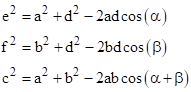
By the law of cosines we have the identities |
|
|
|
|
|
|
|
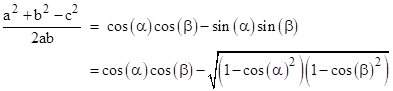
so we can solve these for the cosines of the angles in terms of the segment lengths. Making use of the trigonometric expression for the cosine of the sum of two angles, the third expression can be written as |
|
|
|
|
|
|
|
Re-arranging terms and clearing the radical by squaring, we get |
|
|
|
|
|
|
|
Expanding the square on the right side and simplifying gives |
|
|
|
|
|
|
|
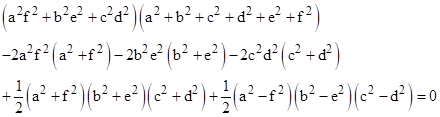
Using the expressions for the cosines of α and β, we can substitute into this equation and clear the denominators to give the result |
|
|
|
|
|
|
|
It’s remarkable that the expression on the left side equals 144V2 where V is the volume of the tetrahedron with the edges a,b,c,d,e,f. The condition for this volume to vanish is for all the edges to be co-planar, which is obvious in retrospect. We could have immediately taken Piero’s formula for the tetrahedron volume, and noted that its vanishing gives the sought relation between the segment lengths for the planar figure. However, it isn’t quite as obvious that the non-zero values of this expression involving the co-planar segment lengths would yield the expression for the squared volume of the tetrahedron. For example, in the next lower dimensional case, Heron’s formula gives 16A2 = (a+b+c)(-a+b+c)(a-b+c)(a+b-c), and three of the factors are indeed the relations between the segments connecting three co-linear points for some permutation of the edges, but this isn’t as unambiguous as the tetrahedral volume case. |
|
|
|
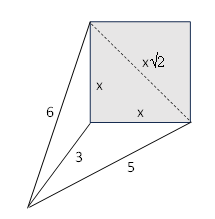
As a check on this result, consider the well-known puzzle that asks for the area of the shaded square in the figure below. |
|
|
|
|
|
|
|
Making the assignments a=6, b=5, d=3, f=e=x, and c=x√2, the above relation reduces to |
|
|
|
|
|
|
|
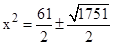
Solving this quadratic for x2 gives |
|
|
|
|
|
|
|
Thus in our example we have the area of the square region |
|
|
|
|
|
|
|
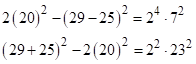
A nicer example is a case in which the area of the square is an integer. Of course we have the degenerate example a=5, b=7, d=4, which gives x=3, but for a less trivial example we can set a=25, b=29, and d=20, each of the factors under the square root are squares, i.e., we have |
|
|
|
|
|
|
|
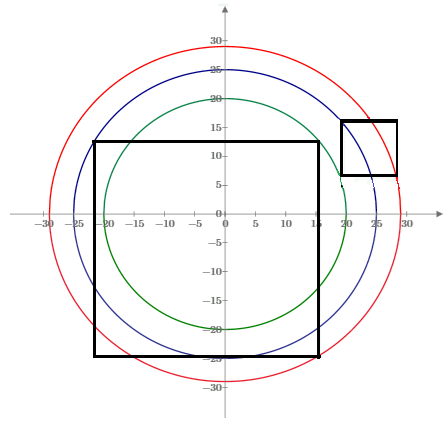
Consequently the two roots of the quadratic for the area in this case are 1377 and 89, corresponding to edge lengths for the square of 37.1079… and 9.43398… respectively. (Of course, to give an integer (or half integer) area, the two factors in the radical need not be squares individually, it is only necessary for their product to be a square, but it’s interesting from a number-theoretic standpoint that both factors can individually be made squares simultaneously.) These two cases are sketched below. |
|
|
|
|
|
|
|
We’ve drawn the squares in alignment for convenience, but they could be rotating about the origin independently. The square with area 1377 encloses the point from which the three specified rays emanate, whereas this point is outside the square with area 89. So, either of these results is correct, depending on whether the point is stipulated to be inside or outside the square. |
|
|