|
A Square Inscribed in a Triangle |
|
|
|
Just give to me my gravestone |
|
With it clearly carved upon: |
|
I was a long time comin’ |
|
And I’ll be a long time gone. |
|
Bob Dylan |
|
|
|
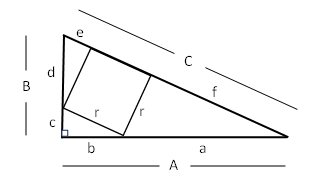
If a square is inscribed in a right triangle with sides A,B,C with hypotenuse C, as depicted below, what is the edge length r of the square in terms of the triangle edges lengths? |
|
|
|
|
|
|
|
By similar triangles we have r/A = d/C and r/C = c/B, and hence c = (B/C)r and d = (C/A)r. Adding these together and noting that c+d=B, we get the result r = ABC/(C2 + AB). |
|
|
|
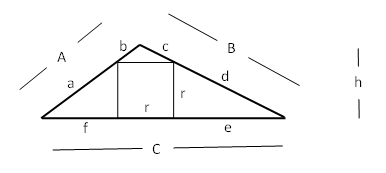
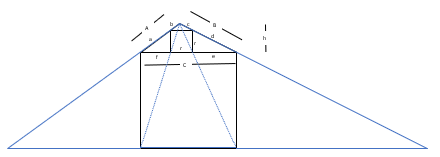
More generally, what is the edge length r of a square inscribed in an arbitrary triangle (not necessarily a right triangle) with edge lengths A,B,C? The situation is as illustrated below. |
|
|
|
|
|
|
|
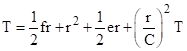
The upper triangle with edge lengths b,c,r is similar to the overall triangle with edge lengths A,B,C, so we have b/A = r/C. Also, letting T denote the area of the overall triangle, we have |
|
|
|
|
|
|
|
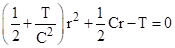
where we have made use of the fact that the area of the small upper triangle is (b/A)2 times the area of the overall triangle, because the ratio of areas is the square of the ratio of corresponding sides. Splitting r2 into halves, and noting that e+r+f = C, this relation can be expressed as |
|
|
|
|
|
|
|
This has the two roots r = -C and |
|
|
|
|
|
|
|
We can express T in terms of the edge lengths A,B,C using Heron’s formula |
|
|
|
|
|
|
|
so we have the square’s edge length r as a function of A,B,C, as required. Of course, if the triangle is a right triangle with hypotenuse C, then T = AB/2, and hence r = ABC/(C2 + AB), confirming the previous result. |
|
|
|
Also, noting that T=(1/2)hC, where h is the altitude on the base C, we have 2T = hC, and therefore r = hC/(C+h), which shows that r is half the harmonic mean of h and C, which is to say |
|
|
|
|
|
|
|
It’s interesting to compare this with the harmonic relation (as shown in another note) involving the radius of a circle inscribed in a trapezoid. |
|
|
|
One might wonder about the root we disregarded, r = -C. That could be interpreted as a square of edge length C constructed on the opposite of the edge C. We can see immediately that this leads to a telescoping construction of geometrically increasing and decreasing size, as depicted below. |
|
|
|
|
|
|
|
We could draw another even smaller square on top of the upper square, and another even larger square below the lower square. These triangles and inscribed squares are in geometric progression with the ratio r/C, and it’s clear that the two upper vertices of each square lie along two straight lines from the top vertex of the triangle, and likewise the two lower vertices of each square lie along two lines emanating from the top vertex of the triangle. Thus, one way of constructing the inscribed square with base on edge C in a triangle is to construct an outer square on edge C and then connect the vertices of that square to the opposite vertex of the triangle. The intersections with the edge C are the vertices of the inscribed square. |
|
|